what conditions lead people to change their party identification?
Partisan affiliation has shifted in small merely of import ways several times over the by two decades, with several politically consequential changes occurring the in past few years. Later on property a 10-percentage indicate 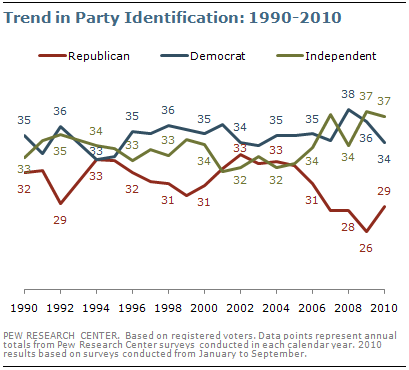 advantage in party identification among registered voters in 2008 and 2009, the Democratic Party at present has just a five-point atomic number 82 in 2010. Fewer voters identify as Democrats and more identify as Republicans.
This year, 34% of registered voters identify as Democrats and 29% as Republicans. In 2009, on average, 36% identified as Democrats, compared with 26% who said they were Republicans, little diff
erent from 2008 when Democrats had a 38% to 28% advantage over Republicans. The Autonomous Party'southward x-betoken lead in 2008 and 2009 grew from a much more than small 35% to 31% gap in 2006 and a narrow 34% to 33% border in 2002.
Amidst these ups and downwardly in amalgamation with the ii major parties, the number of independents and non-partisans now stands at 37%, 1 of the highest levels in the by twenty years of Pew Inquiry Center polling. The proportion of independents has fluctuated in recent years, merely the current number is sharply higher than it was several years ago (32% in 2002).
 The recent changes in partisan identification serve equally a reminder that affiliation with a political party is an attitude, i which can and does change. Previous research has shown that few people switch immediately from Republican to Democratic identification or vice versa. Near of the movement is from independents who assume a party label or from partisans who no longer identify with their quondam party.
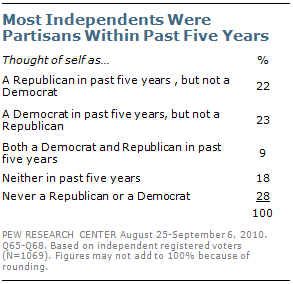
In fact, most of the survey's independent and not-partisan voters report changing their party affiliation – 72% say they take thought of themselves equally a Republican, a Democrat or both at some betoken in their life and 54% considered themselves a partisan in the by v years. Nearly i-in-v independent voters (22%) say they considered themselves a Republican (but non a Democrat) during this period, while 23% of independents considered themselves a Democrat (but non a Republican).
More Independents Lean Republican
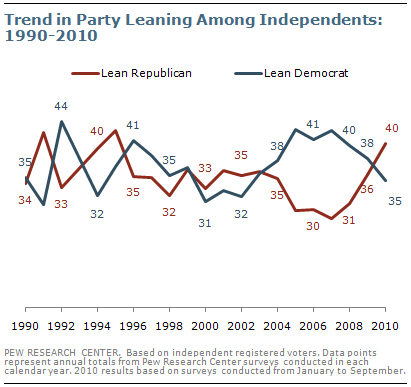 In 2010, twoscore% of independents and other non-partisan voters say they lean more to the Republican Party, 35% say they lean more to the Democratic Party; and 25% of independents turn down to lean. These numbers reflect considerable change over the past four years.
But a year agone, 36% of independents leaned to the GOP and 38% leaned Democratic, while 26% did not state a preference for either party. Consequently, over the past year political party leaning among independent voters has shifted from a two-point Democratic lead to a v-point Republican advantage. And the shift is even more than dramatic from 2006 when Democrats enjoyed an xi-betoken lead in independent leaning.
In the current survey, 84% of Republican leaners program to vote for the GOP candidate in their district this November (compared with 94% among Republicans) and 82% of Democratic leaners plan to vote for the Autonomous Political party's candidate (compared with 91% amid Democrats). Past comparison, the majority (58%) of those who practice non lean to either party are undecided, while 21% support the Republican candidate and 21% dorsum the Democratic candidate for Congress.
The growth in the percentage of independents who lean Republican has been accompanied past an uptick in the proportion who draw their views as bourgeois. Currently, 36% of independents say they are conservative, upwardly from 29% in 2006. Over the same catamenia, the proportion of contained who are moderates declined from 46% to 43%, while the number describing themselves as liberal edged downward ii points (from 18% to 16%). (For more on ideological shifts among the electorate, encounter pg.30).
Why Independents Are Independent
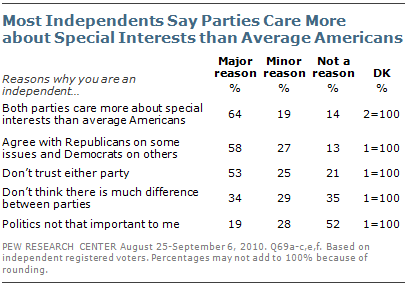 In response to a series of questions about why they are independent, majorities of non-partisan voters cite three different factors as major reasons for rejecting a party label. About 2-thirds (64%) say that both parties caring more about special interests than about average Americans is a major reason for their contained status. A smaller 53% majority says a major reason for being independent is that they don't trust either party.
Nearly six-in-x (58%) say a major reason they are non-partisan is that they hold with the Republicans on some bug and the Democrats on other issues. For example, pluralities of independents say the GOP comes closer to their views on some issues and the Democrats come closer on others. More independents say the Republican Party comes closer to their views than the Democratic Party on economic problems (43% Republican vs. 34% Democrat) and foreign policy and national security (44% Republican vs. 30% Democrat). Simply the Democrats have an border over Republicans on social problems among non-partisans (39% Democrat, 33% Republican).
Less commonly cited were two other reasons for beingness an independent, including a conventionalities that in that location is piffling deviation between the parties. About a third (34%) says not thinking in that location is much departure between the parties is a major reason for their contained condition. Only 19% of not-partisans say that a major reason they are independent is because politics is non that important to them.
Ex-Partisans Back up Their Sometime Parties
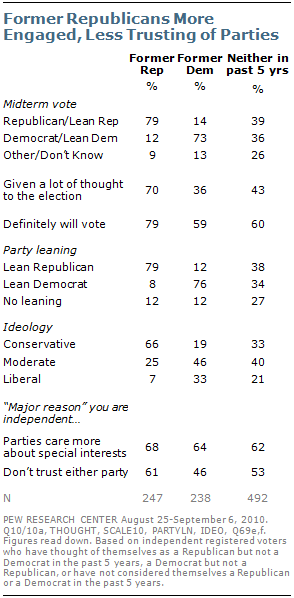 Independents who say they previously identified every bit Republicans or Democrats have positive views of their former parties. Fully 79% of independent voters who thought of themselves as Republicans in the past five years lean to the GOP and the same pct (79%) favors the Republican candidate in their district.
Similarly, former Democrats overwhelmingly lean Democratic (76%) and plan to vote for a Democrat in November (73%). And but as voters who affiliate with the Republican Party are more than engaged in the election, the aforementioned is true among independents who used to vest to the GOP: 79% say they will definitely vote and 70% say they are giving a lot of thought to the ballot. That compares with but 59% and 36%, respectively among onetime Democrats.
The midterm preferences of independents who accept not recently considered themselves a Democrat or a Republican are much more than divided – 39% favor the GOP candidate and 36% dorsum the Autonomous candidate while 26% are undecided. There is a similar blueprint in their partisan leaning; 38% lean to the Republican Party, 34% to the Democratic Political party and 27% reject to lean to either party. But the plurality of this group voted for Obama over McCain in 2008 (41% Obama, 27% McCain). Among the independents who have been consistently nonpartisan over the by five years, 43% have given a lot of thought to the election and 60% say they definitely will vote, about on par with one-time Democrats.
When it comes to political ideology, sometime Republicans are far more conservative than other independents. About two-thirds (66%) draw their political views equally conservative, 25% as moderate and simply vii% as liberal. Past contrast simply 19% of former Democrats say their political views are conservative, 46% are moderate, and 33% are liberal. A third of independents who have not been a Republican or a Democrat in the past five years describe their views as bourgeois, 40% as moderate, and 21% as liberal.
For the nigh part, former Republicans, former Democrats and voters who take not recently considered themselves partisans agree on the reasons why they are independents. For instance, large majorities in all 3 groups say both parties care more than nigh special interests than almost average Americans. Just 61% of sometime Republicans say they do not trust either party, compared with 46% of erstwhile Democrats. Virtually half (53%) of those who have not recently affiliated with a party say they do not trust either party.
Where Republicans, Former Republicans Differ
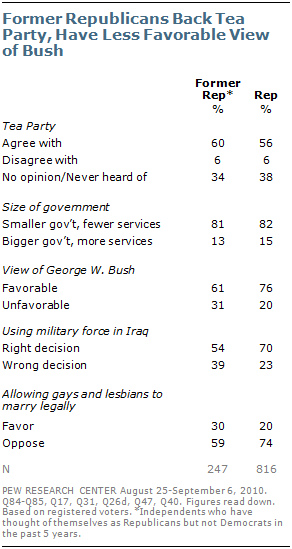 Erstwhile Republicans share many opinions with Republican partisans – peculiarly virtually Barack Obama and the size of government. Just there are also key differences of opinion about George Westward. Bush, the Iraq war and social issues.
Notably, Tea Party support is equally high among former Republica
ns equally it is among Republicans – lx% of erstwhile Republicans and 56% of Republicans agree with the Tea Party move. Similarly, 81% of quondam Republicans say they would rather have a smaller authorities with fewer services, as practice 82% of Republicans.
Nearly as many quondam Republicans (81%) as Republicans (85%) disapprove of Obama's job functioning. Disapproval of wellness intendance reform is most as high amidst former Republicans (81%) equally it is amidst Republicans (87%).
But former Republicans limited a less favorable view of George W. Bush – 61% have a favorable opinion of him compared with 76% of Republicans. And 1 of the major policies of the Bush-league administration, the Iraq war, garners much less back up amongst former Republicans than among Republicans – 54% of former Republicans say the U.S. made the right decision in using armed services forcefulness in Iraq while lxx% of Republicans say it was the right conclusion.
At that place are besides differences over social problems. Almost six-in-x (59%) former Republicans oppose allowing gays and lesbians to marry legally while thirty% favor this. Just Republicans oppose aforementioned-sexual activity matrimony past a 74% to twenty% margin. And while at to the lowest degree three-fourths of former Republicans say the GOP comes closer to their views on economic issues (79%) and foreign policy and national security (76%), only lx% say the same well-nigh social issues such as same-sex marriage and abortion.
Where Democrats, Former Democrats Differ
Former Democrats express less positive views about Obama and his policies than do Democrats. On ratings of Obama'due south overall job performance, 65% of former Democrats approve, compared with 83% of Democrats. And while Democrats support the health intendance reform legislation by more than four-to-one (76% approve, 18% disapprove), the margin is smaller among onetime Democrats (59% approve, 30% disapprove).
In that location also are sharp differences in views about government. Only 22% of former Democrats trust the authorities in Washington to do what is correct just about always or most of the fourth dimension, compared with 41% of Democrats. Democrats prefer bigger government with more services over a smaller one by near 2-to-ane (61% bigger, 31% smaller). Opinion about the size of government is much more divided among former Democrats – 46% prefer a bigger authorities while 44% would rather have a smaller government.
However, erstwhile Democrats and their partisan counterparts have more like views about business organisation and social issues. About seven-in ten quondam Democrats (71%) and Democrats (69%) think that business corporations make too much profit. And a nearly identical percentage of Democrats (58%) and former Democrats (59%) favor allowing gays and lesbians to ally legally. Similarly, 57% of former Democrats think our land needs to go along making changes to give blacks equal rights with whites, as practise 63% of Democrats.
Ideological Shifts among Independents, Partisans
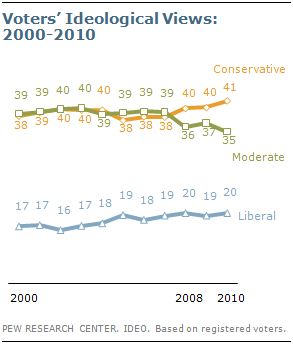 For almost of the concluding decade the political credo of American voters has been very stable. From 2000 to 2007, roughly 4-in-ten voters described themselves as moderate and an equal share every bit conservative. About two-in-10 thought of themselves as liberal. In the last three years, still, the share identifying as conservative increased and the percentage identifying every bit moderate declined.
Amongst voters interviewed in 2010, 41% describe themselves every bit politically conservative. While conservative ideology is upwards 3 points from 2007 – the year Democrats assumed control of Congress – the percent who phone call themselves moderate is down iv points (from 39% in 2007 to 35% in 2010). One in v (20%) say they are liberal, about the same per centum as in the past few years.
Some of the growth in conservative credo is amid Republican voters, but not all can be attributed to change amidst Republicans. Independents, specifically those who lean Republican, have become more bourgeois in recent years.
Since 2006, the twelvemonth of the last midterm election, the percentage of Republican voters who telephone call themselves conservative increased 4 points, from 66% to lxx%. This is non a new trend within the Republican Political party. The share of Republicans who phone call themselves bourgeois has grown since 2002, when 63% of Republicans chosen themselves conservative.
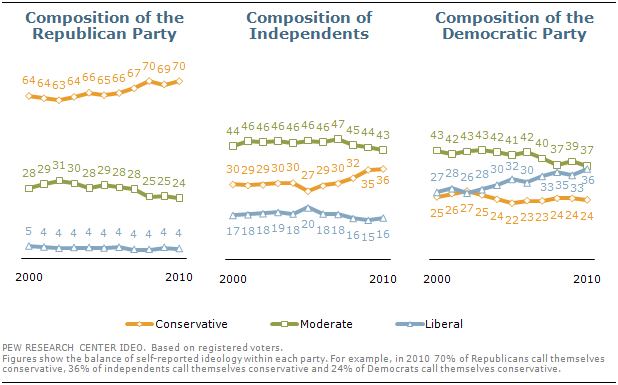
What has changed since the last midterm election is a growing pct of independents who describe themselves as conservative. From 2006 to 2010, the share of independents who call back of themselves as conservative increased vii points from 29% to 36%. Some of this increase may be owing to the decline in Republican Party amalgamation observed from 2006 to 2009. Nigh two-in-ten (22%) of those who have shed their party affiliation in the concluding five years say they once thought of themselves as a Republican and fully two-thirds (66%) of this group call themselves conservative.
To be sure, not all of the growth in bourgeois ideology among independents is owing to lapsed Republican identity. Republican Political party affiliation increased three percentage points from 2009 to 2010 (26% to 29%), while independent identity remained stable, yet the percentage of independents calling themselves bourgeois edged slightly upward from 35% in 2009 to 36% in 2010.
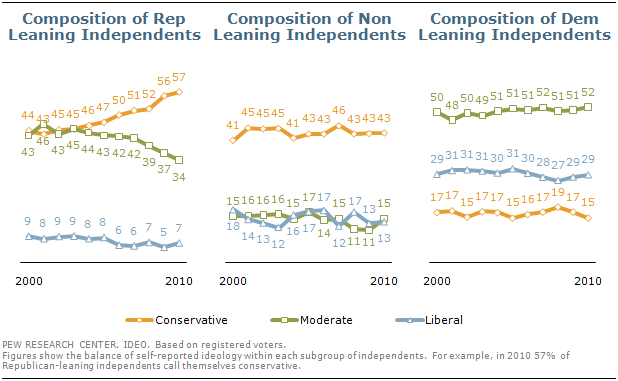
Amongst Republican-leaning independents and non-partisans, conservative ideology both predominates and has steadily increased. Republican leaning independents are far more conservative today than simply a few years ago. Currently, 57% of Republican leaning independents call themselves bourgeois and just 34% are moderate. In 2003, Republican leaning independents were but as probable to be moderate as conservative (45%). There is no comparable pattern amid independents who lean Democratic or independents who do not lean toward a party. Today, 43% of not-leaning independents are conservative, only two points higher than in 2000. And only 15% of Democratic-leaning independents are conservative now, down two points from 2000.
Source: https://www.pewresearch.org/politics/2010/09/23/section-3-trends-in-party-affiliation/
0 Response to "what conditions lead people to change their party identification?"
Enregistrer un commentaire